
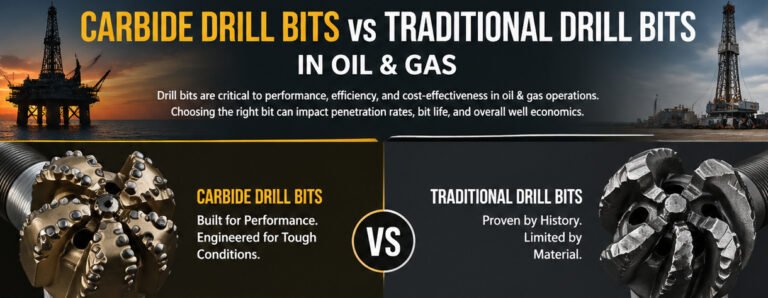
The selection of drill bit technology represents one of the most critical decisions in upstream oil and gas economics. With drilling costs consuming 30–60% of total well expenditure, the shift from traditional roller cone assemblies to advanced carbide matrix systems has fundamentally altered completion strategies across conventional and unconventional reservoirs. This analysis examines the engineering distinctions, performance metrics, and formation-specific applications that differentiate tungsten carbide drill bits from legacy steel-tooth and insert technologies.
Understanding Traditional Drill Bit Technologies
Traditional drill bits—encompassing milled-tooth (steel-tooth) and tungsten carbide insert (TCI) roller cone configurations—have dominated petroleum drilling since the 1900s. These tri-cone systems operate through a crushing and grinding mechanism, where three rotating cones equipped with either machined steel teeth or sintered carbide inserts fracture rock through compressive force and gouging action.
Mechanical Characteristics:
- Bearing Systems: Journal bearings or roller bearings enable cone rotation under high weight-on-bit (WOB) conditions
- Cutting Structure: Intermeshing teeth patterns designed for specific formation hardness ranges (IADC classification D1-D8)
- Hydraulics: Nozzle configurations directing drilling fluid to clean cuttings and cool bearings
While tricone drill bits demonstrate superior performance in highly deviated wellbores and heterogeneous formations with alternating hard stringers, they exhibit significant limitations in extended-reach drilling (ERD) and high-rate penetration (ROP) scenarios. The mechanical complexity of bearing systems creates inherent failure points, with typical runs requiring multiple bit trips in abrasive sandstone or cherty limestone intervals.
The Engineering Evolution of Carbide Drill Bits
Modern carbide drill bits—primarily Polycrystalline Diamond Compact (PDC) configurations and thermally stable polycrystalline (TSP) variants—represent a paradigm shift in cutting mechanics. Unlike the crushing action of roller cones, these fixed-cutter tools utilize synthetic diamond tables sintered onto tungsten carbide substrates, creating shearing mechanisms that reduce energy consumption by 30–50% compared to conventional fracturing methods.
Material Science Foundations:
- Substrate Composition: 6–16% cobalt-bonded tungsten carbide (WC-Co) providing impact resistance while maintaining 1,400–1,600 HV hardness
- Diamond Interface: Polycrystalline diamond layer (2.5–4.0 mm thickness) with 90–95% density offering 8,000–10,000 HV hardness
- Matrix Body: Infiltration-processed tungsten carbide powder (90–95% WC) with copper-nickel binder systems for erosion resistance
Advanced manufacturing techniques, including three-dimensional printing of bit bodies and leaching processes to remove cobalt from diamond tables (to prevent thermal degradation above 750°C), have extended carbide bit applications into previously restricted high-temperature environments.
Comparative Performance Analysis: Field Data and Engineering Metrics
Quantitative differentiation between carbide and traditional bit performance requires analysis of ROP durability, mechanical specific energy (MSE), and cost-per-foot economics across standardized formation conditions.
Rate of Penetration (ROP) Efficiency:
Field studies from the Permian Basin and Bakken Formation demonstrate that PDC carbide bits achieve ROP values 3–5 times higher than roller cone equivalents in shale and carbonate intervals. In the Wolfcamp formation specifically, matrix-body PDC bits consistently deliver 150–250 ft/hr in the lateral section, compared to 40–80 ft/hr for TCI roller cones under identical WOB (25,000–35,000 lbs) and RPM (120–180) parameters.
Footage and Longevity:
Carbide drill bits eliminate moving parts, reducing catastrophic bearing failures. In abrasive Silurian sandstone drilling (Mohs hardness 6–7), modern PDC bits equipped with premium cutters achieve 8,000–12,000 ft per run, whereas TCI bits typically require replacement every 2,000–4,000 ft due to gauge wear and insert fracture.
Mechanical Specific Energy (MSE):
MSE analysis indicates carbide shearing mechanisms operate at 15,000–25,000 psi, compared to 35,000–50,000 psi for crushing-based roller cone systems. This reduction in required energy translates to decreased torque fluctuations (±5% variance vs. ±15–20% for roller cones), minimizing downhole vibrations and improving directional control in steerable motor assemblies.
Formation-Specific Selection Criteria
Despite carbide technological advantages, roller cone bits retain critical applications where formation heterogeneity and mechanical shock loads predominate.
Soft to Medium Formations (Claystone, Salt, Chalk):
Carbide PDC bits with high cutter density (60–80 cutters for 8.5" bits) and aggressive back-rake angles (15–20°) optimize ROP in plastic formations. The shearing action prevents balling tendencies common with roller cone bit tooth packing.
Hard and Abrasive Formations (Granite, Chert, Quartzite):
When drilling through igneous basement rock or conglomerates with compressive strengths exceeding 25,000 psi, hybrid bits combining carbide cutters with roller cone elements (Kymera-style configurations) or robust TCI bits with optimized insert protrusion (0.3–0.5") demonstrate superior durability. Traditional TCI bits withstand impact loading better than fixed-cutter systems when encountering intermittent hard stringers.
Directional and Horizontal Drilling:
Carbide matrix bits dominate lateral section drilling due to consistent torque response and gauge protection through tungsten carbide hardfacing. The ability to maintain toolface orientation without bearing-induced torque spikes improves sliding efficiency in positive displacement motor (PDM) and rotary steerable system (RSS) applications by 25–40%.
Engineering Challenges: Thermal Degradation and Impact Resistance
Thermal Stability Limitations:
Carbide PDC cutters experience rapid wear when formation temperatures at the cutter/rock interface exceed 350–400°C (662–752°F), triggering graphitization of the diamond lattice. In geothermal drilling or deep gas wells where bottom-hole temperatures surpass 150°C (302°F), traditional roller cone bits or thermally stable polycrystalline (TSP) carbide variants outperform standard PDC configurations.
Cutter Chipping and Impact Damage:
While carbide materials exhibit extreme hardness, brittleness remains a concern. Impact loads from interbedded formations cause micro-chipping (spalling) at diamond/carbide interfaces. Recent advancements including chamfered cutter geometries (0.010"–0.030" chamfers) and non-planar interfaces (NPI) have improved impact resistance by 40–60%, yet roller cone bits still prevail in severe vibration environments or when drilling through float equipment and casing shoes.
Economic Analysis: Total Cost of Ownership
Initial acquisition costs favor traditional steel-tooth bits ($5,000–$15,000 for 12¼" bits) versus premium carbide matrix PDC bits ($25,000–$60,000). However, total drilling economics favor carbide technologies through reduced trip times and increased rate of penetration.
Cost-Per-Foot Calculations:
In Marcellus Shale horizontal wells, comprehensive field data indicates:
- Roller Cone: $45–$65 per foot (including 3–4 bit trips per lateral)
- Carbide PDC: $25–$35 per foot (single bit completion of 8,000–10,000 ft lateral)
The elimination of tripping operations (8–12 hours per trip at $50,000–$80,000/day rig costs) generates incremental savings of $150,000–$300,000 per well, offsetting higher drill bit procurement expenses within the first 500 feet of improved performance.
Material Innovations and Future Trajectories
Emerging technologies continue blurring the distinction between carbide fixed-cutter and traditional roller cone categories. Hybrid bit designs incorporating carbide cutting structures with rolling elements address vibration dampening while maintaining shearing efficiency. Additionally, nano-crystalline diamond coatings (NCD) applied to carbide substrates through chemical vapor deposition (CVD) processes promise 300% improvement in abrasion resistance compared to conventional PDC materials.
Advanced matrix powder metallurgy utilizing spherical tungsten carbide grains (2–6 μm) with gradient cobalt distribution enhances fracture toughness (15–20 MPa·m½) while preserving erosion resistance, extending carbide bit viability into harder, more abrasive formations previously dominated by roller cone technologies.
Conclusion
The transition from traditional roller cone bits to carbide-based fixed-cutter systems reflects broader industry imperatives for efficiency and automation. While roller cone technologies retain necessity in specific high-impact, high-temperature, or heterogeneous formation scenarios, carbide drill bits—particularly advanced PDC configurations—deliver superior economic returns through enhanced ROP, extended downhole longevity, and compatibility with automated drilling systems. Selection protocols must integrate real-time formation evaluation, vibration monitoring data, and total cost-per-foot modeling rather than relying solely on initial procurement costs or historical preferences.
