
PDC Drill Bits: Technical Architecture for Demanding Geologies
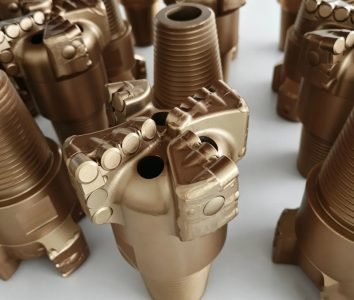
PDC(Polycrystalline Diamond Compact) drill bits represent the convergence of advanced materials science and precision manufacturing. Unlike conventional roller cone assemblies, polycrystalline diamond compact cutters deliver continuous shearing action with no moving parts, eliminating bearing failures and reducing tripping frequency in abrasive sandstone, hard shale, and interbedded formations.
Our engineered matrix-body and steel-body configurations utilize thermally stable diamond (TSD) cutters with optimized cobalt leaching depths, delivering measurable improvements in both mechanical specific energy (MSE) reduction and total drilling cost per foot.
Common PDC Drill Bit Specifications for Oil & Gas Industry
| Bit Diameter (in) | Cutter Type | PDC Thickness / Size | Connection | Suitable Formation | Notes |
|---|---|---|---|---|---|
| 6¼ | Standard PDC | 0.5–1 mm | 3½" REG | Shale, soft sandstone | Common for small-diameter wells |
| 7⅝ | Standard PDC | 1 mm | 4½" IF | Shale, sandstone, limestone | Medium hardness formations |
| 8½ | Standard PDC | 1–1.5 mm | 4½" IF | Sandstone, hard shale | Widely used in oil & gas drilling |
| 9⅞ | Reinforced PDC | 1.5 mm | 6⅝" IF | Medium to hard formations | High wear resistance, deep wells |
| 12¼ | High-wear PDC | 1.5–2 mm | 6⅝" IF | Hard sandstone, limestone | Large-diameter drilling |
| 14½ | High-wear PDC | 2 mm | 6⅝" IF | Hard rock, volcanic rock | Special formations |
| 17½ | High-performance PDC | 2 mm | 8⅝" IF | Extremely hard formations | Ultra-deep wells |
PDC Drill Bit Material Types
| PDC Bit Material Type | Body Material | Cutter Material / Features | Key Properties | Typical Formation Suitability | Notes |
|---|---|---|---|---|---|
| Steel Body PDC | 4140H Alloy Steel, optional AR400 hardfacing | Standard PDC cutters (2–4 μm diamond, 2–2.5 mm table) | High ductility, impact-resistant, allows complex blade geometries | Hard shale, interbedded formations, formations with nodules | Best for directional or horizontal wells requiring custom blade geometry |
| Matrix Body PDC | Tungsten carbide powder infiltrated (94% WC / 6% Co) | Thermally stable PDC cutters (TSD) | Extremely wear-resistant, superior erosion resistance, more brittle | Abrasive sandstones, quartz-rich formations | Ideal for high abrasion, high-solid-content drilling fluids |
| Hybrid Body PDC | Combination steel + matrix sections | Standard or TSD PDC cutters | Balanced toughness and wear resistance | Variable formations, mixed soft/hard sequences | Combines best of steel and matrix; reduces catastrophic cutter failure in interbedded zones |
| Thermally Stable Diamond (TSD) Cutter PDC | Steel or Matrix Body | Diamond microstructure engineered for 2–4 μm grain, gradient cobalt content | Withstands high temperatures (>750°C), reduced thermal degradation | HPHT wells, carbonate or siliceous formations | Enhances PDC drill bits longevity in high-temperature drilling |
| High-Density Diamond Table PDC | Steel or Matrix Body | Thicker diamond table (2.5–3 mm), higher diamond volume | Maximized abrasion resistance | Very hard, abrasive formations | Reduces wear and chipping in extremely hard rock |
Dual-Body Architecture: Matching Material Science to Application Demands
Matrix Body PDC Bits
Manufactured through infiltration sintering of tungsten carbide powders (94% WC, 6% Co binder), matrix bodies offer superior erosion resistance in high-solid-content drilling fluids. The inherent hardness (HRA 88-90) withstands gauge wear in quartz-rich formations where steel-body alternatives experience material loss exceeding 3mm per 100 meters.
Steel Body PDC Bits
Fabricated from 4140H modified alloy steel with selective hardfacing (AR400-grade weld overlays), steel-body designs accommodate complex blade geometries impossible to achieve in powdered metallurgy. The ductile substrate absorbs 40% higher impact energy before cutter failure in chert nodules or pyrite lenses.
| Parameter | Matrix Body | Steel Body |
|---|---|---|
| Erosion Resistance | Superior (WC matrix) | Moderate (requires hardfacing) |
| Impact Absorption | Brittle (12-15 J/cm²) | High (45-50 J/cm²) |
| Cutter Placement Precision | ±0.15mm | ±0.05mm |
| Repairability | Limited | Field-rebuildable |
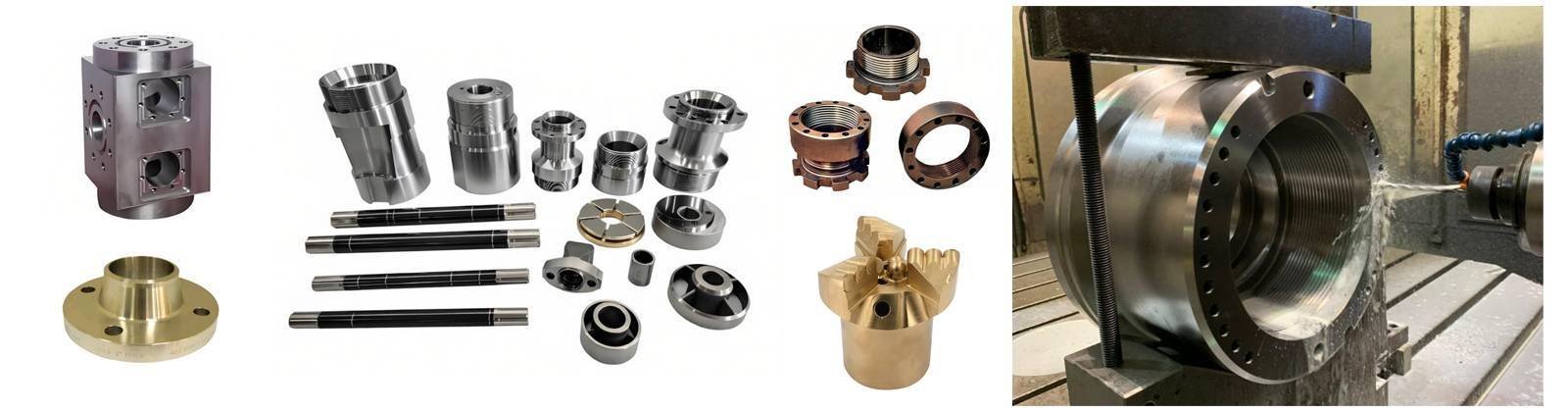
PDC Drill Bit CNC Machining
PDC drill bits require precision CNC machining to achieve optimal performance in demanding drilling conditions. The process focuses on body shaping, cutter pocket creation, blade profiling, and connection threads, with strict tolerances to ensure durability, cutter retention, and efficient cutting.
Body Machining
- Steel Body: Machined from 4140H alloy steel, optionally with hardfacing. CNC milling and turning shape blade contours, gauge surfaces, and nozzle holes.
- Matrix Body: Machined from tungsten carbide-cobalt composite (94% WC / 6% Co). Requires diamond-coated tools or EDM for cutter pockets and face contouring due to high abrasiveness and brittleness.
- Hybrid Body: Combines steel and matrix zones; machining must account for different hardness levels and thermal expansion.
Cutter Pocket Machining
- Ensures precise seating of PDC cutters for optimal rake and back angles.
- CNC methods: milling for steel bodies, EDM for matrix zones.
- Typical tolerances: ±0.05 mm (steel), ±0.15 mm (matrix).
- Challenges: avoiding micro-cracks, maintaining angular alignment, ensuring uniform pocket depth.
Blade and Profile Machining
- Blade geometry affects ROP, vibration resistance, and cuttings removal.
- CNC milling, often 5-axis, creates complex non-planar contours, gauge surfaces, and junk slots.
- Blade accuracy is critical for directional and horizontal wells.
Thread and Connection Machining
- API-standard threads (IF or REG) are cut using CNC lathes to ±0.02 mm tolerance.
- Runout at gauge must remain below 0.15 mm TIR to ensure connection integrity.
Quality Control
- CMM inspections verify blade geometry and cutter pocket placement.
- Ultrasonic testing detects voids in matrix bodies.
- Brazing tests confirm cutter attachment (>200 MPa shear strength).
- Hardness verification ensures steel and matrix properties meet specifications.
Technical Specifications & API Standards
- API Connection: 3-1/2" IF to 7-5/8" REG (API 7-1 compliant)
- Bit Diameter Range: 3-3/4" to 17-1/2" (custom sizes available)
- Thread Tolerance: API Class II (±0.38mm pitch diameter)
- Runout Tolerance: <0.15mm TIR at gauge
- Standard Cutter Sizes: 13mm, 16mm, 19mm diameter
- Diamond Table Thickness: 2.0mm - 2.5mm
- Leaching Depth: 150-300μm (customizable for high-temperature applications)
- Quality Assurance: Ultrasonic testing, brazing validation (>200 MPa), CMM inspection ±0.025mm
Operational Note: For formations exceeding 25,000 psi UCS with high quartz content, consider hybrid PDC/TCI designs or consult engineering for cutter density optimization based on mud weight and ROP targets.
