
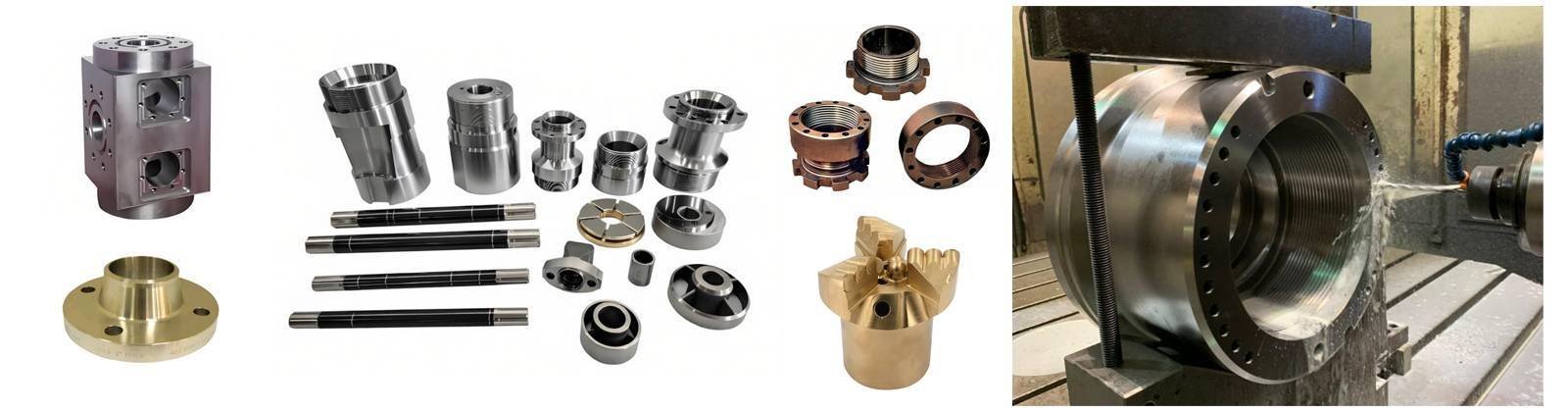
Flange bushings are mission-critical components in oil and gas equipment, providing axial positioning, radial load support, and sealing interfaces in wellheads, Christmas trees, manifolds, and rotating machinery. At Jupai, we manufacture custom CNC-machined flange bushings from API-grade alloys and corrosion-resistant materials (CRAs), ensuring compliance with API Spec 6A, API 16C, and NACE MR0175/ISO 15156 for sour service environments containing H₂S.
Whether you need a wear bushing for casing head protection, a thrust flange bushing for axial load management, or a self-lubricating bushing for maintenance-free operation in remote locations, our CNC machining capabilities deliver tolerances down to ±0.005 mm with surface finishes as fine as Ra 0.4 μm.
What Is a Flange Bushing?
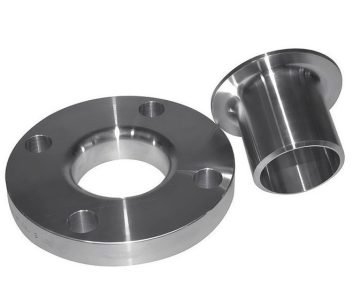
A flange bushing is a cylindrical bearing element with an integral radial flange at one or both ends. The sleeve portion supports radial loads and guides rotational or oscillating motion, while the flange face provides:
- Axial thrust containment – prevents shaft or component migration
- Sealing surface – interfaces with gaskets or O-rings to prevent fluid leakage
- Mounting reference – ensures precise axial positioning during assembly
In oil and gas applications, flange bushings function as sacrificial wear surfaces that protect expensive wellhead components, valve bodies, and casing heads from erosion and galling during drilling, completion, and production operations.
Material Selection for Oil & Gas Flange Bushings
Material selection is governed by API 6A material classes (AA through HH) and NACE MR0175 requirements for sour service. The table below maps common oil and gas service conditions to recommended bushing materials:
| Service Condition | API Material Class | Recommended Material | Key Properties | Typical Application |
|---|---|---|---|---|
| General service, non-corrosive | AA / BB | AISI 4130 / 4140 Alloy Steel | High strength (75K yield), impact resistant, cost-effective | Wellhead wear bushings, running tools |
| General service, moderate corrosion | CC | 316/316L Stainless Steel | Corrosion resistant, good machinability, broad temperature range | Valve stems, tubing hangers |
| Sour service (H₂S present) | DD / EE | AISI 4130/4140 + NACE compliance (22 HRC max) | Sulfide stress cracking (SSC) resistant per NACE MR0175 | Casing heads, choke manifolds |
| Severe sour service | FF / HH | 17-4PH, Duplex 2205, Super Duplex 2507 | Superior SSC and chloride SCC resistance, high PREN | Subsea wellheads, BOP components |
| Extreme sour + high chloride | HH | Inconel 718, Alloy 625, Hastelloy C276 | Exceptional corrosion resistance, high temperature stability | Christmas trees, high-pressure valves |
| Self-lubricating, dry running | – | CuZn25Al5Mn4Fe3 + Graphite plugs | Maintenance-free, PV limit 1.65–3.25 N/mm²·m/s, temp -40°C to +200°C | Offshore equipment, remote pumping units |
Duplex vs. Super Duplex for Offshore & Subsea
For subsea flange bushings exposed to seawater and high chloride concentrations, Duplex 2205 (UNS S32205) offers a PREN of ~35–36, suitable for moderate chloride service with good flow conditions. However, Super Duplex 2507 (UNS S32750) with a PREN of 40–43 is the preferred engineering choice for direct seawater immersion, splash zones, and crevice-prone geometries where deposits may accumulate.
CNC Machining Capabilities & Tolerances
Our oil and gas flange bushings are manufactured via multi-axis CNC turning and milling from forged or centrifugally cast blanks, ensuring full material traceability per API PSL-3/PSL-4 requirements.
| Parameter | Standard Tolerance | High-Precision Option |
|---|---|---|
| Inside Diameter (ID) | H7 (+0.021 mm for Ø20 mm) | H6 (+0.013 mm) |
| Outside Diameter (OD) | h6 / g6 (shaft fit) | Custom interference fits |
| Flange Thickness | ±0.05 mm | ±0.02 mm |
| Flange OD | +0.5/-0.8 mm (6–18 mm bore) | +0.2/-0.3 mm |
| Concentricity (ID to OD) | ≤0.05 mm | ≤0.01 mm |
| Surface Finish – Bore | Ra 1.6–3.2 μm (turned) | Ra 0.4–0.8 μm (ground/honed) |
| Surface Finish – Flange Face | Ra 1.6 μm | Ra 0.8 μm (sealing surfaces) |
Critical Machining Considerations for Oil & Gas
- Surface Integrity: Sealing faces and bores requiring RTJ (Ring Type Joint) compatibility are finish-machined to Ra ≤0.8 μm to ensure gasket conformance and leak-free performance under pressures up to 20,000 PSI.
- Oil Groove Geometry: For lubricated bronze or steel bushings, groove patterns are CNC-machined based on motion type:
- Figure-8 grooves: Optimal for oscillating motion – ensures bidirectional lubricant redistribution
- Spiral/helical grooves: Ideal for continuous rotation – creates a pumping effect
- Circumferential + axial grooves: Standard for general rotating shafts – provides reservoir capacity and axial distribution
- Hardness Control for NACE Compliance: For sour service classes DD/EE, post-machining heat treatment ensures hardness ≤22 HRC or ≤237 HBW per NACE MR0175 to prevent sulfide stress cracking.
Surface Treatments & Coatings
| Treatment | Purpose | Application |
|---|---|---|
| Electroless Nickel Plating (ENP) | Uniform hardness, corrosion/wear resistance, improved lubricity | High-precision aerospace and downhole tools |
| Hard Chrome Plating | Extreme wear resistance, low friction | Hydraulic cylinders, valve stems |
| Zn-Cr Coating | Salt-spray resistance, no hydrogen embrittlement | Marine and offshore structural bushings |
| PTFE Coating | Self-lubrication, chemical inertness | Low-friction robot joints, precision instruments |
| Phosphating | Paint adhesion, moderate corrosion protection | Automotive and general industrial pre-treatment |
| Passivation (Stainless Steel) | Restores corrosion-resistant oxide layer | 316L and duplex stainless components |
Quality Assurance & Compliance
- Material Certification: Full MTR (Material Test Report) with chemical composition and mechanical properties per API 6A
- NACE MR0175/ISO 15156: Hardness testing and material qualification for sour service
- Dimensional Reporting: CMM (Coordinate Measuring Machine) inspection with ballooned drawings
- Non-Destructive Testing (NDT): MPI and LPI per API standards
- Pressure Testing: Hydrostatic testing available up to 30,000 PSI test pressure for API 6BX equivalent ratings
Applications in Oil & Gas Operations
| Equipment Type | Bushing Function | Critical Requirement |
|---|---|---|
| Wellhead Casing Heads | Wear bushing – protects sealing surfaces during drilling | API 6A, PSL-3, DD/EE material class |
| Christmas Trees | Thrust bushing – axial load support for tubing hanger | NACE MR0175, high temperature class (X/Y) |
| BOP Stack | Guide bushing – alignment of ram shafts | Impact resistance, tight concentricity |
| Choke & Kill Manifolds | Flange adapter bushing – pressure containment | API 16C, H₂S compatibility |
| Subsea Production Systems | Corrosion-resistant bushing – seawater exposure | Super Duplex 2507, cathodic protection compatibility |
| Pumping Units & Compressors | Self-lubricating bushing – maintenance-free operation | High PV value, solid lubricant embedded |
Material & Machining Insights
Why Graphite-Embedded Bronze Outperforms Oil-Impregnated Bronze in Remote Oilfield Locations
While oil-impregnated sintered bronze (SINT A51, ~28% porosity) is common for general industrial use, its operating temperature is limited to +90°C and requires consistent lubricant replenishment. In contrast, graphite-embedded aluminum bronze (CuZn25Al5Mn4Fe3) operates from -40°C to +200°C with a solid lubricant matrix that does not deplete. Field data from offshore platforms indicates that graphite-embedded bushings reduce unplanned maintenance by 40–50% compared to traditional oil-impregnated designs in oscillating and slow-speed rotating applications.
The Hidden Cost of Poor Groove Design
A common failure mode in oil and gas flange bushings is localized seizure caused by inadequate lubricant distribution. Machining a simple axial groove in a bushing intended for rotational motion can reduce the effective load-bearing area by 15–20% and create starvation zones. The Figure-8 groove pattern, while more complex to machine via CNC, maintains >95% lubricant coverage across the bearing surface during bidirectional operation, critical for wellhead linkages and BOP hinge mechanisms.
Machining Duplex Stainless Steel: What Buyers Should Know
Duplex 2205 and 2507 present unique CNC machining challenges due to their high work-hardening rate. Without optimized cutting parameters (low speed, high feed, rigid fixturing), tool life can be reduced by 60–70% compared to machining 316L. Our programming team utilizes adaptive toolpaths and ceramic insert technology to maintain dimensional stability and surface integrity on duplex bushing bores, ensuring NACE-compliant hardness without secondary stress-relief operations.
