
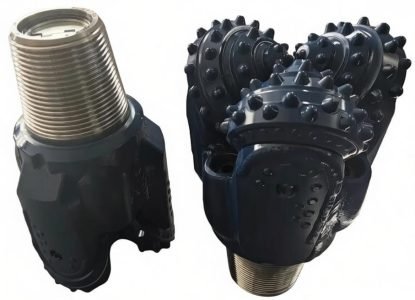
Tricone drill bits remain the industry standard for versatile rock penetration across unpredictable geological strata. Our CNC-precision-manufactured tricone bits combine tungsten carbide insert (TCI) technology with optimized bearing geometries to deliver superior rate of penetration (ROP) in formations ranging from soft shale to crystalline quartzite.
Unlike fixed-cutter alternatives, tricone bits utilize three individually rotating cones with intermeshing cutting structures that crush and grind formation material through combined rolling and wedging actions. This mechanical advantage produces consistent cuttings evacuation while minimizing axial vibration—critical factors for maintaining borehole stability in deviated drilling applications.
Material Composition & Metallurgical Specifications
Our tricone bits utilize aerospace-grade alloys and advanced hardfacing materials engineered for extreme abrasion resistance and impact toughness.
| Component | Material Grade | Hardness/Properties | Manufacturing Process |
|---|---|---|---|
| Cone Body | AISI 4145H Modified Alloy Steel | 285-341 BHN (Base) | 5-Axis CNC Machining → Normalizing → Surface Hardening |
| Tungsten Carbide Inserts | WC-Co (6-13% Cobalt Binder) | 88-92 HRA | Sintered via Hot Isostatic Pressing (HIP) |
| Journal/Bearing Surfaces | Carburized 9310 Steel | 58-62 HRC (Case) | CNC Grinding to 0.0005" Tolerance |
| Gage Protection | Premium Tungsten Carbide Inserts + Hardfacing | 60+ HRC Overlay | Automated PTA (Plasma Transferred Arc) Welding |
| Seals | HNBR (Hydrogenated Nitrile) or Viton™ Fluoroelastomer | -20°F to 350°F Operating Range | Precision Molded + CNC Trimmed |
| Bit Body (Legs) | 4140H Cr-Mo Alloy | 300-350 BHN | Multi-Stage Heat Treatment |
CNC Manufacturing Excellence: From Raw Forging to Field Deployment
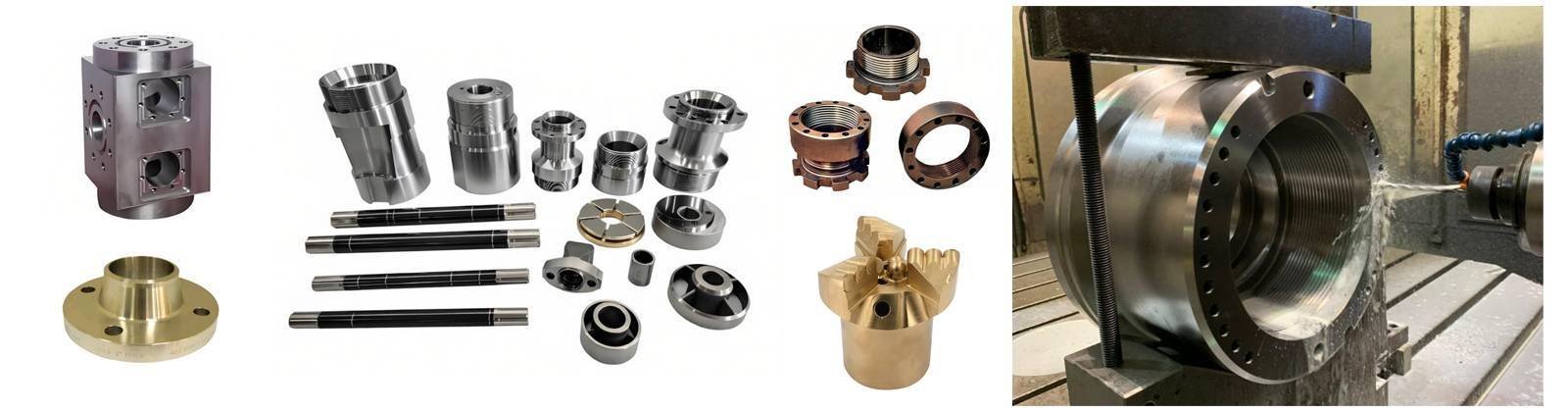
Our vertically integrated tricone drill bits manufacturing facility utilizes 5-axis simultaneous CNC machining centers to achieve geometric tolerances unattainable through conventional casting methods. This precision directly correlates with bearing alignment accuracy and cutting structure balance.
Cone Profile Grinding
Each cone undergoes CNC form grinding using diamond-impregnated wheels, ensuring exact cutter placement angles (typically 33°-42° journal angle depending on formation hardness). This precision eliminates eccentric rotation, reducing bearing wear by up to 40% compared to conventionally machined competitors.
Journal Bearing Micro-Finishing
Final journal surfaces are honed to 4-8 microinch finish using superfinishing CNC equipment. This surface quality reduces friction coefficients to <0.08 under 50,000 PSI bearing loads, extending operational life in high-RPM applications.
Insert Press-Fit Interference
Tungsten carbide inserts are installed using 0.0015"-0.002" interference fits calculated via finite element analysis (FEA). Our hydraulic press stations maintain ±50 PSI consistency, preventing insert loss in high-impact drilling while optimizing stress distribution across the cone matrix.
Hardfacing Automation
Gage row protection and heel row reinforcement utilize robotic PTA welding systems with Stellite® or tungsten carbide composite wires. Deposition rates are CNC-controlled to 0.030"-0.045" thickness, providing uniform wear resistance without thermal distortion of base materials.
Engineering Solutions for Real-World Drilling Challenges
Problem: Premature Bearing Failure in High-Water-Content Formations
Solution Implementation: Our sealed bearing tricone configurations utilize metal-face seals with dual HNBR O-rings, achieving 98% exclusion efficiency against drilling fluid intrusion. Field data from the Permian Basin demonstrated 287 hours average bearing life versus 164 hours for standard sealed bearing designs—representing a 75% improvement in downhole reliability.
Problem: Gage Deterioration in Abrasive Sandstone
Solution Implementation: Strategic placement of 16mm premium carbide inserts on the gage row combined with diamond-enhanced inserts (DEI) on the heel row. Recent deployment in the Marcellus Shale (Middle Devonian sandstone intervals) showed 0.12-inch gage wear after 1,400 feet of drilling, compared to 0.38-inch wear on standard TCI bits—maintaining 97% original hole diameter throughout the run.
Problem: Balling in Hydratable Clay Formations
Solution Implementation: Optimized tooth count and relief angles with enhanced hydraulics. Our soft-formation tricone bits feature increased cone offset (3-4mm) and deep cone profiles that create shearing action rather than crushing, preventing clay accumulation. ROP improvements of 35-50% were documented in the Eagle Ford Shale claystone sections compared to conventional mill-tooth designs.
IADC Classification & Selection Matrix
Understanding International Association of Drilling Contractors (IADC) codes ensures proper bit selection for specific lithologies:
| Series | Formation Type | Cutting Structure | Bearing/Seal | Our Engineering Enhancement |
|---|---|---|---|---|
| 1-2-3 | Soft (Shale, Clay, Salt) | Long projection, spaced inserts | Standard roller | Enhanced cone offset for shearing action |
| 4-5 | Medium (Siltstone, Sandstone) | Medium projection, tightly spaced | Sealed roller | Optimized insert geometry for chip formation |
| 6-7-8 | Hard (Dolomite, Granite, Chert) | Short projection, high-density | Journal/sealed | Premium carbide grades (K30-K40) with 13% cobalt binder |
Technical Specifications & Performance Metrics
Dimensional Standards
- Sizes Available: 3 7/8" to 26" (98.4mm - 660.4mm)
- Thread Connections: API Reg, FH, IF, PAC; Premium double-shoulder connections available
- Journal Angle Variations: 33° (Soft) / 36° (Medium) / 42° (Hard)
Operational Parameters
- Weight on Bit (WOB): 2,000 - 10,000 lbs/inch of bit diameter
- Rotation Speed: 60-300 RPM (formation dependent)
- Flow Rate: 250-1,200 GPM (based on annular velocity requirements)
Performance Benchmarks
- Average ROP in Medium Hardness: 45-85 ft/hour
- Total Depth Capability: 8,000-15,000 feet (depending on formation abrasiveness)
- Bearing Hours (Sealed): 200-400 hours continuous rotation
Quality Assurance Protocols
Every tricone bit undergoes dimensional verification using CMM (Coordinate Measuring Machine) inspection to confirm:
- Cone rotation eccentricity: <0.002"
- Interfit clearances: ±0.001"
- Bit runout (TIR): <0.010"
Pressure Testing: Sealed bearing units are validated at 5,000 PSI differential pressure for 15 minutes with helium leak detection (sensitivity to 1×10⁻⁶ cc/sec).
Material Certification: Full mill test reports (MTRs) available for all alloy components, including Charpy impact test data (-20°F, -40°F) and ultrasonic testing (UT) results for forged legs.
Application Engineering Support
Our technical team provides formation analysis compatibility studies utilizing Mohs hardness scale correlations and compressive strength data (unconfined compressive strength, UCS). We manufacture tricone configurations specifically optimized for:
- Geothermal drilling: High-temperature seal compounds (400°F+ rating)
- Reverse circulation: Enhanced flushing geometries with enlarged junk slots
- Directional drilling: Low-torque cutting structures for motor-driven assemblies
Custom cutting structures available for non-standard applications, including specialized insert geometries for reef carbonates or fractured basalts.
Manufactured under API 7-1 / ISO 10424-1 specifications. All dimensional tolerances adhere to API 7-2 threading standards. Material traceability maintained per API Q1 quality management protocols.
