
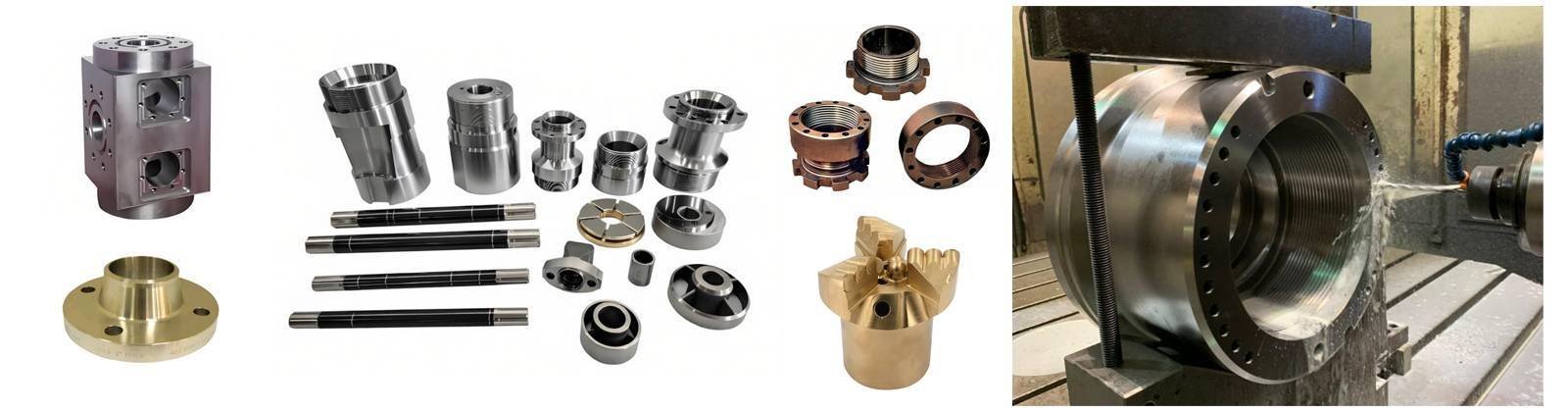
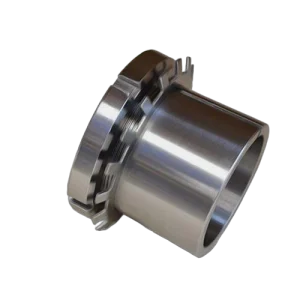
Engineering Solutions for Extreme Hydrocarbon Environments
In upstream oil and gas operations, sleeve bushings function as critical load-bearing interfaces within drilling assemblies, wellhead control systems, and high-pressure hydraulic manifolds. Unlike standard industrial bearings, these components must withstand simultaneous radial and axial shock loads, hydrostatic pressures exceeding 15,000 psi, and corrosive attack from H₂S, CO₂, and chloride-rich drilling fluids—often at temperatures fluctuating between -50°C and +200°C.
Our CNC machining facility specializes in monobloc (weld-free) sleeve bushing manufacturing, utilizing 5-axis simultaneous milling and precision turning centers to achieve geometric tolerances critical for API 6A and API 7K compliance. By eliminating welded seams and maintaining granular material continuity from forged billet to finished component, we mitigate fatigue failure risks inherent in vibratory downhole environments.
Metallurgical Matrix: Material Selection for Sour Service & Abrasive Media
Material specification determines service life in oilfield bushings. The table below correlates common hydrocarbon operating conditions with optimal alloy selections and corresponding CNC machinability indices:
| Material Grade | Primary Alloy | Hardness (Post-HT) | Corrosion Resistance | Typical Application | Machining Notes |
|---|---|---|---|---|---|
| C63000 | Ni-Aluminum Bronze | HB 180-220 | Excellent seawater/brine resistance; anti-galling | Subsea BOP rams, marine riser tensioners | Requires rigid tooling; chip control critical |
| C95400 | Aluminum Bronze | HB 140-180 | High abrasion resistance; low friction coefficient | Mud pump crossheads, valve actuators | Work-hardens rapidly; optimized cutting speeds |
| Cu-Ni 90/10 | Cupronickel | HB 90-120 | Superior salt spray resistance; biofouling reduction | Platform seawater cooling systems | High ductility; precision honing required |
| 17-4PH | Precipitation Hardened SS | HRC 32-38 | Moderate H₂S resistance; high strength | Hydraulic fracturing manifolds | Solution anneal before finish machining |
| Duplex 2205 | 22% Cr Duplex SS | HRC 28-32 | SCC resistance in sour service (NACE MR0175) | Christmas tree valve guides, wellheads | Balanced ferrite/austenite structure |
| AISI 4340 | Ni-Cr-Mo Alloy Steel | HRC 28-36 | Toughness under impact; case hardenable | Drill collar connections, heavy-wall subs | Pre-hardened stock available; IT7 tolerances achievable |
| Inconel 718 | Ni-Cr Superalloy | HRC 36-42 | Extreme temperature/pressure oxidation resistance | HPHT downhole motors | Ceramic tooling required; slow speeds |
For applications involving sulfide stress cracking (SSC) risks, we recommend specifying materials meeting NACE MR0175/ISO 15156 hardness limits (<HRC 22 for carbon steels, <HRC 32 for CRAs). Our metallurgical team provides failure mode analysis (FMEA) prior to material finalization, particularly for sour gas wells where hydrogen embrittlement presents catastrophic failure vectors.
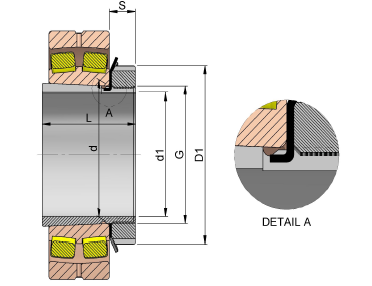
5-Axis CNC Precision Architecture
Geometric Integrity Through Monobloc Manufacturing
Traditional split-sleeve or welded bushing constructions introduce stress concentration zones vulnerable to cyclic fatigue in drilling vibrations. Our manufacturing protocol employs:
- Single-setup 5-axis machining: Internal bores, external profiles, flange faces, and seal grooves completed without workpiece repositioning, ensuring concentricity runout ≤ 0.01mm (IT7-IT8 tolerance class).
- Forged billet substrate: ASTM A29 4140/4340 or ASTM B150 C63000 starting stock provides directional grain flow aligned to load paths, yielding 20-30% superior impact resistance compared to cast equivalents.
- Precision honing operations: Post-CNC internal grinding achieves surface finishes of Ra 0.2-0.4 μm (8-16 μin), critical for hydraulic seal compatibility and prevention of mud particle embedding.
Tolerance Engineering for Critical Fits
| Parameter | Standard Tolerance | Precision Grade | Metrology Method |
|---|---|---|---|
| ID/OD Concentricity | ≤0.05mm TIR | ≤0.01mm TIR | CMM with 0.001mm resolution |
| Length Parallelism | 0.03mm/100mm | 0.01mm/100mm | Granite surface plate, indicator |
| Surface Roughness (ID) | Ra 0.8 μm | Ra 0.2-0.4 μm | Profilometer, ISO 4287 |
| Wall Thickness Variance | ±0.10mm | ±0.03mm | Ultrasonic thickness gauge |
Product Configuration Spectrum
Standard Geometric Profiles
1. Straight Cylindrical Sleeves
- Uniform wall thickness for general radial load distribution
- Preferred for drill string stabilizer internals and pump wear rings
- Standard length-to-OD ratios: 0.5:1 to 3:1
2. Flanged Shoulder Bushings
- Integral thrust face for axial load accommodation
- Critical for wellhead hanger assemblies and hydraulic cylinder pivot mounts
- Flange thickness engineered per API 6A pressure ratings (PSL 1-4)
3. Stepped & Profiled Configurations
- Multi-diameter transitions for seal stack accommodation
- Internal snap ring grooves, lubrication channels, and keyways via 4th-axis interpolation
- Typical in MWD (Measurement While Drilling) tool housing bearings
4. Extreme Aspect Ratio Designs
- Thin-wall precision (wall thickness <3mm): For weight-sensitive downhole tools; requires cryogenic machining protocols to prevent distortion
- Heavy-wall pressure vessels (wall thickness >50mm): For subsea hydraulic couplings; deep-hole boring capabilities to L/D ratios of 10:1
Bushing Performance Metrics & Technical Specifications
Dimensional Envelope
- Bore Diameter Range: 10mm – 1000mm
- Length Capacity: Up to 3,000mm single-piece
- Wall Thickness: 1mm – 500mm+ (application dependent)
Operational Capability Parameters
- Pressure Rating: Up to 20,000 psi working pressure (static)
- Temperature Range: -60°C to +300°C (material dependent)
- PV Value: Up to 75,000 psi·ft/min (lubricated bronze alloys)
- Hardness Delta: Matched to mating shaft (typically RC 3-5 points differential for anti-galling)
Surface Engineering Options
- Electroless Nickel Plating: 25-50μm thickness for salt spray protection (ASTM B733)
- Hard Chrome: 30-100μm for abrasion resistance in sandy formations
- Phosphating: Manganese phosphate for oil retention in slow-speed reciprocation
- Passivation: Citric or nitric acid per ASTM A967 for stainless cleanliness
Application-Specific Engineering Solutions
Downhole Drilling Assemblies
Problem Context: PDC bit sleeves experience tri-axial shock loads (axial WOB + lateral vibration + torsional stick-slip) while exposed to weighted drilling mud (pH 9-11, solids-laden).
Solution Architecture:
- 4340 steel body with nitrided bore (HV 900-1100) for abrasion resistance
- Radial lubrication ports machined at 15° helical pattern to prevent cuttings packing
- H7/g6 transition fit specified for thermal expansion compensation at 150°C bottom-hole temperatures
Hydraulic Fracturing Manifolds
Problem Context: High-cycle fatigue in zipper manifold bushings subjected to 15,000 psi pressure spikes at 1-2 Hz frequency during frac operations.
Solution Architecture:
- 17-4PH H1150M condition for toughness/tensile balance (UTS ≥ 930 MPa)
- Cross-hatched honing pattern (30° included angle) to retain molybdenum disulfide coatings
- Edge break radii ≥0.5mm to mitigate stress risers under pulsatile pressure
Subsea Christmas Trees
Problem Context: 20-year design life exposure to seawater galvanic corrosion and cathodic protection over-voltage risks.
Solution Architecture:
- C63000 aluminum bronze with cathodic disbonding resistance
- Flange faces machined to API 6A Type 6BX ring groove tolerances
- Absolute cleanliness protocols (ASTM G93 Level 100) to prevent chloride-induced crevice corrosion
Bushing Manufacturing Excellence & Quality Protocols
Process Chain Control
- Incoming Material Verification: Mill test reports (MTRs) validated against ASTM specifications; PMI (Positive Material Identification) for each heat number
- In-Process Metrology: On-machine probing (OMP40) for intermediate feature verification; SPC charts for critical-to-quality (CTQ) dimensions
- Final Inspection: CMM (Coordinate Measuring Machine) dimensional reports, surface roughness profiling, and dye penetrant inspection (ASTM E165) for surface integrity
- Documentation Package: Material certificates, heat treatment charts, dimensional inspection reports, and NDT certification available per customer ITP (Inspection Test Plan)
Equipment Portfolio
- 5-Axis Machining Centers: DMG MORI DMU series for complex envelope geometries
- Deep Hole Drilling: BTA drilling systems for L/D >10:1 hydraulic passages
- Precision Honing: Sunnen CV-616 for bore geometry correction to 0.002mm cylindricity
Bespoke Engineering Workflow
Technical Consultation Phase
Our engineering team analyzes CAD/STEP files or physical samples to assess:
- Fit classification: Clearance, transition, or interference fits per ISO 286 or ANSI B4.1
- Lubrication regime: Hydrodynamic vs. boundary lubrication conditions affecting surface finish specifications
- Failure mode mitigation: Specific attention to fretting corrosion in oscillating applications or cavitation in high-velocity flows
Prototyping & Validation
- Rapid CNC turnaround for functional prototypes (3-5 days for standard alloys)
- Dimensional correlation studies between CMM data and customer assembly gauges
- Material certification traceability maintained from prototype to production lots
Production Scalability
- Low-volume: 1-50 pieces for custom tool trials or repair scenarios
- High-volume: Automated bar feed systems for 500+ piece campaigns with statistical process control
Technical Standards Compliance
Manufacturing processes align with API Specification Q1 (Quality Management), API 6A (Wellhead Equipment), and API 7K (Drilling Equipment) where applicable. Material certifications include ASTM, ASME, and NACE MR0175/ISO 15156 conformance declarations for sour service applications.
