
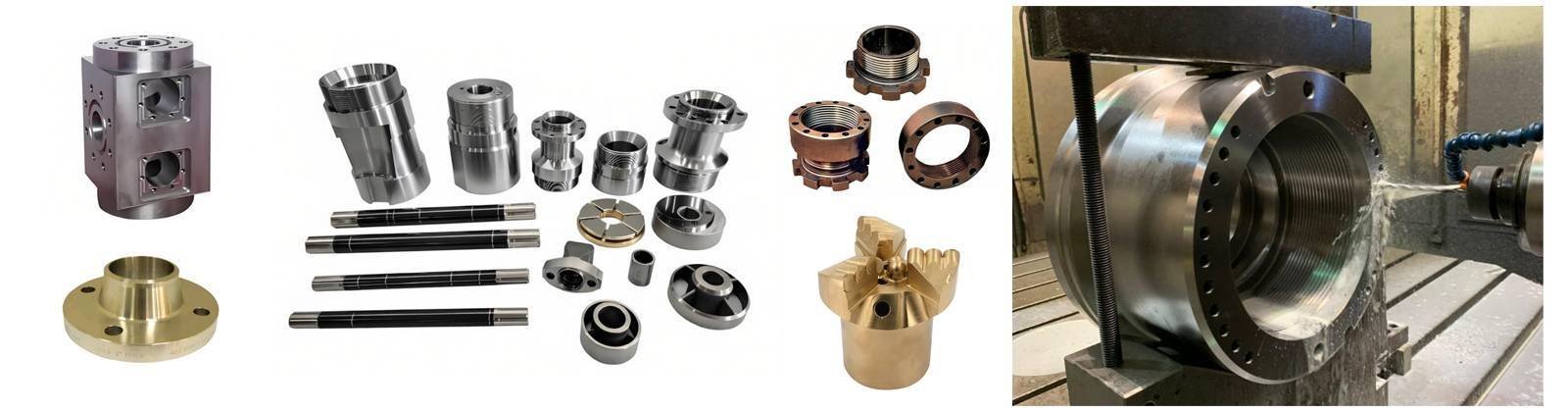
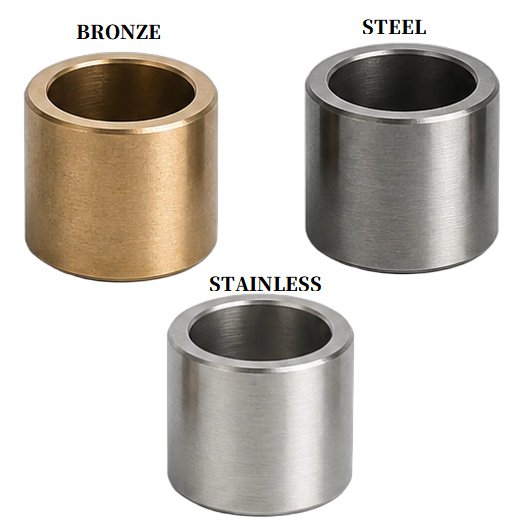
Selecting the correct bushing material—bronze, hardened steel, or stainless steel—directly determines the service life, maintenance interval, and total cost of ownership for rotating and sliding machinery. While all three materials serve the same fundamental function of reducing friction between a shaft and housing, their tribological behavior, corrosion resistance, load capacity, and lubrication requirements differ by an order of magnitude. This guide provides quantified property comparisons, real-world failure modes, and a decision framework grounded in PV (Pressure × Velocity) engineering limits.
Material Fundamentals and Metallurgical Distinctions
Bronze Bushings: The Tribological Workhorse
Bronze is not a single material but a family of copper-based alloys engineered specifically for bearing surfaces. The most common grades for bushings include:
| Alloy (UNS) | Common Name | Tensile Strength | Hardness (HB) | Primary Engineering Role |
|---|---|---|---|---|
| C93200 | SAE 660 Bearing Bronze | 240–310 MPa | 65–80 | General-purpose, medium load, excellent embeddability |
| C95400 | Aluminum Bronze | 580–630 MPa | 150–170 | High load, shock resistance, superior seawater corrosion resistance |
| C86300 | Manganese Bronze | 750+ MPa | 210–270 | Extreme static load, bridge pins, mining machinery |
The defining characteristic of bearing bronze is its sacrificial wear behavior. Bronze is intentionally softer than the steel shaft it mates with, ensuring that wear occurs in the replaceable bushing rather than the expensive precision shaft . The lead phase in C93200 (6–8% Pb) acts as a solid lubricant, providing a friction coefficient of 0.08–0.12 under oil lubrication and natural anti-seizure properties .
Steel Bushings: Maximum Load, Maximum Dependency
Hardened steel bushings are typically manufactured from:
- AISI 4140/4340: Medium-carbon alloy steel, through-hardened to HRC 50–60
- GCr15 (AISI 52100): High-carbon chromium bearing steel, the global standard for rolling element bearings, achieving HRC 60–64 after quench and temper
- AISI 1045: Surface-hardened carbon steel for moderate-duty applications
Steel bushings offer the highest load capacity and wear resistance in the trio, but with a critical caveat: they require continuous external lubrication. Unlubricated steel-on-steel contact generates friction coefficients of 0.30–0.50, leading to rapid adhesive wear and catastrophic galling within hours of operation .
Stainless Steel Bushings: Corrosion Immunity at a Cost
Stainless bushings are specified primarily for environmental resistance rather than tribological superiority. The two dominant grades are:
| Grade | Key Alloying Element | Tensile Strength | Corrosion Profile | Relative Cost |
|---|---|---|---|---|
| 304/304L | 18% Cr, 8% Ni, no Mo | ~515 MPa | Excellent in atmosphere/freshwater; vulnerable to chloride pitting | Baseline |
| 316/316L | +2–3% Molybdenum | ~515 MPa | Superior chloride/pitting resistance; marine-grade | +10–15% vs 304 |
| 440C | 16–18% Cr, high C | ~860 MPa | Hardenable to HRC 55–60; moderate corrosion resistance | Premium |
The austenitic grades (304, 316) present a unique engineering challenge: their high ductility and tendency toward galling and cold welding under unlubricated contact make them unsuitable for dry-running bearing applications without PTFE coatings or composite liners . The friction coefficient for unlubricated stainless-on-steel mating surfaces approaches 0.58—the highest of the three material categories .
Quantified Performance Comparison
Mechanical and Physical Properties
| Property | Bronze Bushing | Hardened Steel Bushing | Stainless Steel Bushing |
|---|---|---|---|
| Typical Hardness | HB 65–270 (grade-dependent) | HRC 50–64 | HB 150–300 (annealed); HRC 55–60 (440C) |
| Tensile Strength | 240–750 MPa | 620–1,000+ MPa | 515–860 MPa |
| Elastic Modulus | 110–120 GPa | 200–210 GPa | 190–200 GPa |
| Thermal Conductivity | 50–70 W/m·K | 45–50 W/m·K | 15–25 W/m·K (austenitic) |
| Density | 8.8–8.9 g/cm³ | 7.85 g/cm³ | 7.93–8.0 g/cm³ |
Tribological Behavior: Friction, Wear, and PV Limits
The PV value (Pressure × Velocity) is the governing design parameter for plain bearing selection. Exceeding a material's PV limit generates frictional heat faster than it can be dissipated, leading to lubricant breakdown and seizure .
| Parameter | Bronze | Hardened Steel | Stainless Steel |
|---|---|---|---|
| Friction Coefficient (Dry) | 0.10–0.20 | 0.30–0.50 | 0.40–0.60 |
| Friction Coefficient (Lubricated) | 0.03–0.10 | 0.02–0.08 | 0.02–0.10 (with PTFE coating) |
| PV Limit—Dry Running | 1.0–2.8 N/mm²·m/s | 0.5–1.0 (not recommended) | 0.8–1.8 (PTFE-lined composite) |
| PV Limit—Oil Lubricated | 10–25 N/mm²·m/s | 15–50 N/mm²·m/s | 10–30 N/mm²·m/s |
| Self-Lubricating Capability | Yes (oil-impregnated, graphite-plugged) | No | No (requires PTFE liner or coating) |
Critical Insight: Bronze offers the best dry-running PV performance among monolithic metals. Hardened steel achieves the highest lubricated PV limits but collapses immediately without oil. Stainless steel occupies an intermediate position only when converted to a metal-polymer composite (e.g., steel backing + bronze sinter + PTFE overlay) .
Corrosion Resistance Matrix
| Environment | Bronze | Hardened Steel | 304 Stainless | 316 Stainless |
|---|---|---|---|---|
| Atmospheric/Rural | Excellent | Poor (requires coating) | Excellent | Excellent |
| Fresh Water | Excellent | Poor | Excellent | Excellent |
| Seawater/Salt Spray | Good–Excellent (Al-bronze) | Unacceptable | Fair (pitting risk) | Good–Superior |
| Chemical Acids | Moderate | Poor | Good (oxidizing acids) | Excellent |
| Chloride Solutions | Good | Poor | Fair (vulnerable to pitting) | Superior |
Real-World Engineering Applications and Failure Modes
When Bronze Is the Correct Choice
Application: Hydro turbine wicket gate linkages, excavator bucket pins, marine propeller shaft bearings.
Why it wins: In a hydro turbine application operating at 50 MPa bearing pressure and 0.3 m/s sliding velocity (PV = 15 N/mm²·m/s), oil-impregnated C93200 bronze operates safely within its lubricated PV envelope. The self-lubricating graphite-plugged variant (C95400 with embedded graphite) eliminates maintenance access requirements in submerged installations and withstands temperatures up to 450°C in dry conditions .
Failure mode to avoid: Using C93200 in high-impact mining applications without upgrading to C86300 or C95400. The 65–80 HB hardness of SAE 660 bronze will deform under shock loads exceeding its yield strength (~150 MPa), leading to extrusion and seizure .
When Hardened Steel Is the Correct Choice
Application: Automotive suspension control arms, gearbox countershaft bearings, high-speed spindle guides.
Why it wins: A hardened GCr15 steel bushing at HRC 62 paired with a similarly hardened shaft and continuous oil mist lubrication can sustain PV values exceeding 50 N/mm²·m/s—unreachable by bronze or stainless steel in monolithic form . The material cost is the lowest of the three options, making it economically viable for high-volume production.
Failure mode to avoid: Operating without lubrication. In a steel-on-steel dry contact, the friction coefficient spikes to 0.5, generating flash temperatures above 300°C at the asperity level within minutes. The resulting scuffing damage propagates across the entire contact surface, necessitating replacement of both bushing and shaft .
When Stainless Steel Is the Correct Choice
Application: Food processing equipment (FDA-compliant), chemical reactor agitator bearings, cryogenic liquefaction pumps, coastal architectural hardware.
Why it wins: 316L stainless steel maintains structural integrity at temperatures down to -195°C and resists attack from chlorides, organic acids, and caustic cleaning agents . In a pharmaceutical mixing vessel where lubricant contamination is prohibited, a 316 bushing with PTFE composite liner provides both chemical inertness and dry-running capability .
Failure mode to avoid: Specifying 304 stainless bushing for marine or saltwater exposure. Without molybdenum, 304 suffers from chloride-induced pitting corrosion at crevice locations, with penetration rates measurable in millimeters per year in stagnant seawater . Additionally, uncoated austenitic stainless steels are prone to galling—a form of adhesive wear where surface material cold-welds and tears under sliding contact .
Cost-Benefit and Lifecycle Analysis
| Cost Factor | Bronze | Hardened Steel | Stainless Steel |
|---|---|---|---|
| Raw Material Cost | Medium (~30–50% lower than SS) | Low (most economical) | High (304 baseline; 316 +10–15%) |
| Machining Cost | Moderate (excellent machinability for C93200) | Moderate–High (requires grinding after hardening) | High (work-hardening during cutting) |
| Lubrication System Cost | Low to None (self-lubricating variants) | High (pumps, seals, monitoring required) | Moderate (PTFE coating or external lube) |
| Maintenance Interval | 5,000–15,000 hrs (self-lube) | 2,000–5,000 hrs (lube-dependent) | 3,000–8,000 hrs (coating-dependent) |
| Shaft Replacement Risk | Low (sacrificial bushing wear) | High (shaft damage if lube fails) | Moderate (galling risk if uncoated) |
Total Cost of Ownership Insight: While hardened steel bushings have the lowest unit price, the required lubrication infrastructure—oil pumps, filtration systems, seals, and condition monitoring—often makes bronze self-lubricating bushings more economical over a 10-year equipment lifecycle. Stainless steel commands a premium upfront but eliminates replacement costs in corrosive environments where other materials would fail catastrophically.
Selection Decision Framework
Use this sequential logic tree to identify the optimal material:
Step 1: Is the environment corrosive (saltwater, chemicals, food-grade cleaning)?
Yes → Eliminate hardened carbon steel. Proceed to Step 2.
No → Consider all three. Proceed to Step 3.
Step 2: Is chloride exposure present (seawater, de-icing salt, bleach)?
Yes → Specify 316 stainless or aluminum bronze (C95400). Avoid 304.
No (general chemical exposure) → 304 stainless acceptable; bronze remains viable.
Step 3: Is continuous external lubrication feasible and maintainable?
Yes → Hardened steel (GCr15/4140) offers maximum load capacity at lowest cost.
No or intermittent → Specify self-lubricating bronze (oil-impregnated or graphite-plugged).
Step 4: What is the operating PV value?
PV < 2.8 N/mm²·m/s, dry → Bronze or PTFE-composite stainless.
PV > 15 N/mm²·m/s, lubricated → Hardened steel or bronze with oil.
PV > 50 N/mm²·m/s → Hardened steel with forced lubrication only.
Step 5: Is shaft protection a priority (precision shafts, expensive spindles)?
Yes → Bronze is mandatory. Its embeddability traps debris, and its softness prevents shaft scoring .
No → Steel or stainless acceptable with proper hardness matching.
Advanced Considerations: Hybrid and Composite Solutions
Modern bearing engineering increasingly employs multi-material composites that combine the strengths of two or three base materials:
Steel-backed + Bronze Sinter + PTFE Overlay: A steel sleeve provides structural rigidity, a porous bronze interlayer bonds the PTFE and dissipates heat, and the PTFE surface achieves friction coefficients as low as 0.06–0.12 in dry running . This configuration achieves PV limits of 2.8 N/mm²·m/s under grease and 3.6 under oil .
GCr15 Steel + Embedded Graphite: For applications requiring both extreme hardness and self-lubrication, graphite plugs pressed into hardened steel bushings offer HRC 60+ substrate hardness with dry-running capability . This hybrid is increasingly used in aerospace landing gear and heavy mining equipment where maintenance access is impossible.
Conclusion
There is no universal "best" bushing material—only the optimal material for a specific tribological system. Bronze dominates in self-lubricating, shaft-protecting, and medium-to-high load applications. Hardened steel wins in maximum-load, high-speed, well-lubricated systems where cost is constrained. Stainless steel is non-negotiable in corrosive, cryogenic, or hygiene-critical environments, provided its galling tendency is mitigated through coatings or composite construction.
The final specification should always be validated against the PV limit, corrosion exposure map, and lifecycle cost model for the specific application. Consulting manufacturer-specific PV charts and wear rate data remains essential, as alloy heat treatment, casting method, and surface finish introduce performance variations not captured in general material comparisons.
