
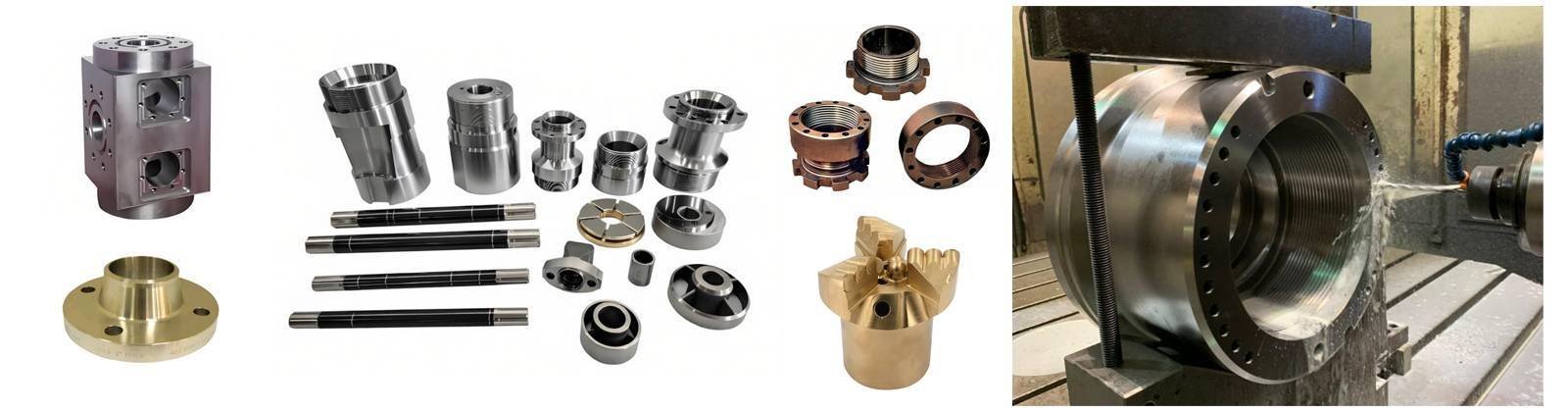
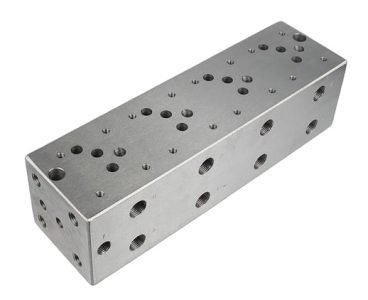
Precision Machining for Hydraulic, Gas & Fluid Control Manifolds
We provide precision manifold block machining services for OEM manufacturers, automation integrators, and industrial equipment suppliers. Our expertise covers hydraulic, pneumatic, vacuum, grease, and compressed air systems where internal flow control, sealing performance, and dimensional accuracy are critical.
Manifold blocks are complex components with intersecting internal passages that distribute fluids or gases within compact systems. Machining these parts requires not only CNC capability, but also deep understanding of drilling strategies, sealing integrity, and contamination control.
- Tolerance up to ±0.002 mm
- Leak-proof internal channels
- Rapid prototyping & low-to-high volume production
- Fast quotation within 24 hours
Types of Manifold Blocks We Machine
We support a wide range of manifold applications. Each type has different engineering requirements, and we tailor machining processes accordingly.
Hydraulic Manifold Block
Hydraulic manifolds are used in high-pressure fluid systems where reliability and sealing are essential. These components involve complex cross-drilled holes and require precise control of alignment and perpendicularity.
👉 View Hydraulic Manifold Block Machining →
Pneumatic Manifold Block
Pneumatic manifolds are commonly used in automation systems to distribute compressed air. They require consistent airflow performance and efficient, repeatable machining, often using aluminum materials.
👉 View Pneumatic Manifold Block Machining →
Vacuum Manifold Block
Vacuum manifolds demand strict leak-tight performance. Surface finish quality and sealing interfaces are critical to maintaining system integrity.
👉 View Vacuum Manifold Block Machining →
Grease Manifold Block
Grease manifolds are used in lubrication systems where flow consistency and contamination control directly affect performance.
👉 View Grease Manifold Block Machining →
Junction Block
Junction blocks are used to connect, distribute, or redirect fluid, air, or hydraulic lines within a system. By integrating multiple ports into a single compact component, they help simplify system layouts, reduce connection points, and improve overall reliability.
👉 View Junction Block Machining →
Oil and Gas Manifold Block
Oil and gas manifold blocks are widely used in upstream, midstream, and downstream operations where precise control and distribution of fluids are required under high-pressure and high-risk conditions.
👉 View oil and gas manifold block machining →
Air Compressor Manifold Block
These manifolds are integrated into compressed air systems and require durability and long-term operational stability.
👉 View Air Compressor Manifold Block Machining →
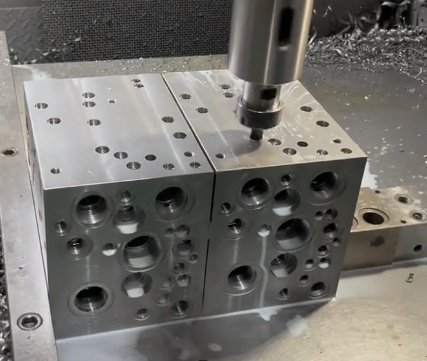
Manifold Block Machining Capabilities
Machining manifold blocks involves multiple specialized processes to create internal flow paths and functional features. Our capabilities include:
- CNC milling (3-axis, 4-axis, 5-axis)
- Deep hole drilling for manifold blocks (critical for internal channels)
- Cross drilling for intersecting passages
- Precision thread machining (NPT, BSP, Metric)
- Internal channel deburring and cleaning
- Surface grinding and finishing
- Honing for enhanced sealing performance
We also provide DFM support to optimize your design for manufacturability, cost efficiency, and performance.
Materials for Manifold Blocks
We machine a wide range of materials based on application requirements, including but not limited to:
| Material Category | Grades / Examples | Key Characteristics | Typical Applications |
|---|---|---|---|
| Aluminum Alloys | 6061, 6063, 7075 | Lightweight, corrosion-resistant, easy machining | Pneumatic, automation systems |
| Carbon Steel | 1018, 1045, A216 | High strength, cost-effective | General industrial manifolds |
| Alloy Steel | 4140, 4130 | High strength, wear resistance | Hydraulic systems |
| Stainless Steel | 303, 304, 316, 17-4PH | Corrosion resistance, durability | Chemical, food, medical |
| Brass | C36000 | Good machinability, corrosion resistance | Low-pressure fluid systems |
| Copper | C11000 | Excellent conductivity, corrosion resistance | Specialized fluid systems |
| Engineering Plastics | POM (Delrin), PTFE, Nylon | Chemical resistance, lightweight | Low-pressure / special media |
| Cast Iron | Gray iron, ductile iron | Vibration damping, strength | Heavy machinery |
| Exotic Alloys | Inconel, Hastelloy | High temperature & corrosion resistance | Oil & gas, extreme environments |
Material selection depends on pressure conditions, corrosion resistance, temperature, and fluid compatibility.
Key Manifold Block Machining Processes We Apply
Manifold blocks are widely used in hydraulic and pneumatic systems to distribute flow between multiple ports. Compared to standard CNC parts, manifold blocks require precise internal channels, accurate port positioning, and reliable sealing surfaces.
We provide machining solutions for a wide range of manifold blocks, from simple configurations to moderately complex designs, ensuring consistent quality and functional reliability.
Drilling and Cross Drilling
Internal channels are typically created through straight drilling and cross drilling. Maintaining accuracy at intersection points is important to ensure proper flow distribution.
We control drilling processes to ensure:
- Reliable channel connectivity
- Stable hole diameters
- Controlled positioning accuracy
CNC Machining and Setup Control
Manifold blocks often require machining from multiple sides. Proper setup and positioning are essential to maintain dimensional consistency.
Our CNC machining approach ensures:
- Accurate port locations
- Good parallelism and perpendicularity
- Reduced setup errors through optimized fixturing
Thread Machining and Port Quality
Threaded ports are essential for connecting fittings and components. Thread accuracy directly affects assembly and sealing performance.
We machine threads according to standards such as NPT, BSPP, and BSPT, with attention to:
- Thread size and pitch accuracy
- Clean and consistent thread profiles
- Proper alignment with internal channels
Surface Finishing for Sealing
Sealing surfaces must meet appropriate roughness requirements to prevent leakage.
We apply suitable finishing processes to:
- Improve sealing performance
- Ensure proper contact with O-rings or fittings
- Maintain surface consistency
Deburring and Cleaning
Deburring is necessary to remove sharp edges and residual material inside and outside the block.
We ensure:
- Clean internal channels
- Removal of loose particles
- Smooth flow paths for stable performance
Common Issues in Manifold Block Machining Services
Even standard manifold blocks can encounter issues during machining that affect performance and reliability.
Channel Misalignment
Inaccurate drilling or positioning can lead to improper channel connections, affecting flow performance.
Burrs and Contamination
Unremoved burrs or chips may block channels or impact downstream components.
Sealing Surface Problems
Poor surface finish may result in leakage at connection points.
Thread Quality Issues
Incorrect or rough threads can cause assembly difficulties or sealing failure.
Dimensional Inconsistency
Variations in machining setups may lead to inconsistent part quality in batch production.
By controlling these key machining processes, we ensure stable performance, reliable sealing, and consistent quality across different types of manifold blocks.
Quality Assurance for Leak-Free Performance
Strict quality control is essential for manifold blocks due to internal channels and sealing requirements. Our inspection process includes:
- Air and water leak testing
- CMM dimensional inspection
- Surface roughness control
- Internal channel cleaning and deburring
- Pressure testing for critical applications
These processes ensure each manifold meets functional and reliability standards.
Applications of Manifold Blocks
Manifold blocks are used in systems where fluid or gas distribution must be compact and efficient. Typical applications include hydraulic power units, industrial automation systems, oil and gas equipment, pneumatic control systems, and centralized lubrication systems.
Why Work With Us for Manifold Blocks Machining Services
We focus on delivering reliable and functional manifold components, not just machined parts. Our advantages include:
- 10+ years of manifold machining experience
- Engineering support for complex designs
- Fast prototyping within 3–10 days
- Stable quality for OEM production
- Strong control over leak-proof performance
FAQ
What is a manifold block used for?
A manifold block distributes fluids or gases through integrated internal channels, reducing external piping.
How do you prevent leakage?
Through precision machining, sealing design, and leak testing before delivery.
What tolerances can you achieve?
Up to ±0.002 mm depending on design and material.
What is your lead time?
3–10 days for prototypes; production depends on quantity.
