
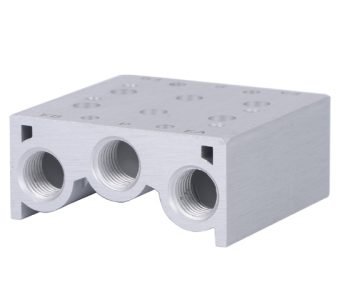
Engineered for Reliability, Flow Efficiency, and Long-Term Performance
In pneumatic systems, the manifold block is not just a connector—it directly affects airflow stability, pressure loss, system response time, and maintenance frequency. Poorly designed or inaccurately machined manifolds often lead to leakage, uneven distribution, and increased downtime.
Our custom pneumatic manifold block machining service focuses on functional performance, not just dimensional accuracy. We optimize internal flow paths, sealing interfaces, and port layouts to ensure your pneumatic system operates efficiently under real-world conditions.
Material Selection Guide for Pneumatic Manifold Block Machining
Choosing the right material is critical for durability, corrosion resistance, and cost efficiency. Below is a practical comparison to support engineering and procurement decisions:
| Material | Key Properties | Typical Applications | Advantages | Considerations |
|---|---|---|---|---|
| Aluminum 6061 | Lightweight, good machinability, corrosion resistant | General industrial automation, robotics | Cost-effective, fast machining, good surface finish | Lower strength than steel |
| Aluminum 7075 | High strength-to-weight ratio | High-pressure pneumatic systems | Stronger than 6061, lightweight | Higher cost, slightly harder to machine |
| Stainless Steel 304 | Excellent corrosion resistance | Food processing, medical equipment | Durable, hygienic, corrosion-resistant | Heavier, higher machining cost |
| Stainless Steel 316 | Superior corrosion resistance (chemicals, salt) | Marine, chemical environments | Excellent chemical resistance | Expensive, slower machining |
| Brass | Good machinability, corrosion resistant | Valve systems, low-pressure manifolds | Smooth threading, good sealing | Lower strength than steel |
| POM (Delrin) | Low friction, lightweight | Compact pneumatic systems | Fast machining, cost-efficient | Limited pressure resistance |
| PTFE | Excellent chemical resistance | Specialized chemical environments | Non-reactive, low friction | Soft material, requires design compensation |
Quality Control and Testing Approach
Quality is not treated as a final step but integrated throughout the manufacturing process.
We perform in-process inspections to detect deviations early, followed by final dimensional verification using precision measurement equipment. For functional assurance, pressure and leak testing can be conducted based on your application requirements.
Material traceability is maintained when required, and inspection reports can be provided to support your internal quality systems.
Tolerance and Technical Specifications
For pneumatic manifold blocks, not all tolerances are equally critical. We focus on functional tolerances that directly affect performance.
Typical capabilities include:
- General tolerance: ±0.01 mm (tight tolerance ±0.002 mm)
- Critical sealing surfaces: tighter control as required
- Thread accuracy: compliant with international standards
- Surface roughness: optimized for sealing and airflow
We also support complex requirements such as deep hole drilling, cross-hole intersections, and multi-axis machining for integrated manifold designs.
From Prototype to Production
We support the full lifecycle of your project, from early-stage validation to stable mass production.
During prototyping, the focus is on speed and flexibility. We help validate design concepts, test airflow performance, and refine specifications before scaling.
In production, the priority shifts to consistency, cost control, and delivery reliability. We implement process standardization, fixture optimization, and quality checkpoints to ensure repeatability across batches.
This approach reduces the risk of design flaws scaling into production issues, saving both time and cost.
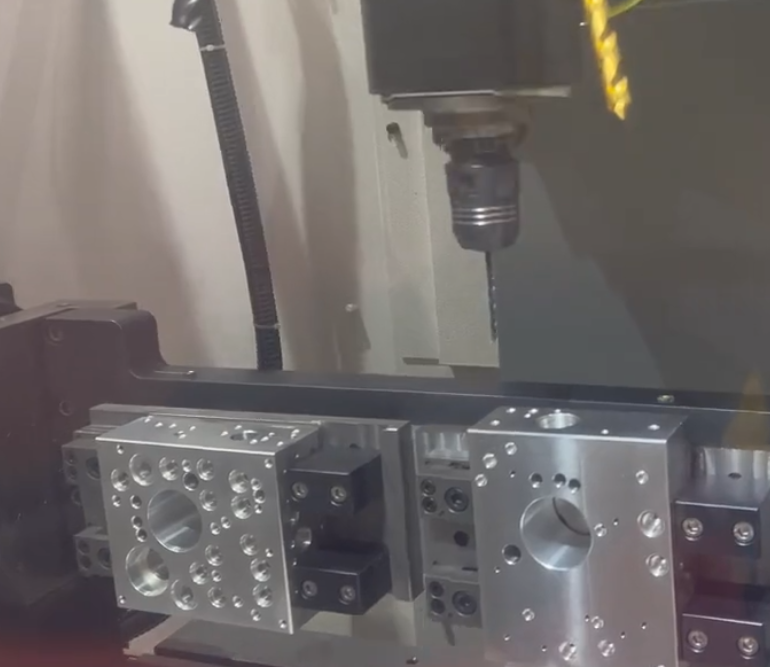
Key Pneumatic Manifold Block Machining Processes We Apply
Pneumatic manifold blocks are fundamentally different from standard CNC parts due to their complex internal channel networks and sealing-critical interfaces. Successful machining requires not only precision equipment, but also a deep understanding of drilling strategies, intersection control, and airflow-oriented design execution.
We specialize in machining manifold blocks with multiple intersecting holes, deep internal passages, and compact multi-port configurations, ensuring that all internal geometries align precisely with the design intent.
Deep Hole Drilling and Cross Drilling
Internal flow channels are often created through deep hole drilling combined with cross-hole intersections. Maintaining positional accuracy at intersection points is critical to avoid flow restriction or blockage.
We control drilling depth, alignment, and tool deflection to ensure:
- Accurate channel connectivity
- Consistent internal diameters
- Minimal deviation in long drilling paths
Multi-Axis CNC Machining
Complex manifold designs require machining from multiple orientations. Our multi-axis CNC capabilities allow precise positioning and reduce cumulative tolerance errors that occur in repeated setups.
This ensures that:
- Port positions are accurately aligned
- Parallelism and perpendicularity are maintained
- Complex geometries are machined in fewer setups
Thread Machining and Port Accuracy
Threaded ports are critical connection points in pneumatic systems. Poor thread quality can lead to leakage or assembly issues.
We machine threads according to international standards such as NPT, BSPP, and BSPT, with strict control over:
- Thread depth and pitch accuracy
- Surface finish for sealing performance
- Alignment with internal channels
Surface Finishing for Sealing Performance
Machining is not complete without proper surface control. Sealing surfaces must meet specific roughness requirements to ensure airtight connections.
We apply controlled finishing processes to:
- Improve sealing reliability
- Reduce micro-leak risks
- Ensure compatibility with O-rings and fittings
Deburring and Internal Cleaning
One of the most overlooked but critical steps in manifold machining is internal deburring. Burrs inside channels can disrupt airflow, detach during operation, and damage downstream components.
We implement thorough deburring and cleaning processes to ensure:
- Smooth internal airflow
- No loose particles inside channels
- Reliable long-term system performance
Common Issues in Pneumatic Manifold Block Machining Services
In pneumatic systems, many performance issues originate from machining defects rather than design flaws. These problems may not be immediately visible but can lead to airflow inefficiency, leakage, and long-term system instability.
We address these risks through controlled and specialized machining processes.
- Internal Channel Misalignment
Misaligned cross-drilled channels can restrict airflow and cause pressure instability. We ensure precise alignment through multi-axis CNC machining, optimized drilling sequences, and accurate fixturing. - Burrs and Internal Contamination
Residual burrs or particles inside channels can disrupt airflow and damage downstream components. We apply thorough internal deburring and cleaning to ensure smooth, contamination-free flow paths. - Poor Sealing Surface Finish (Leakage Risk)
Inadequate surface roughness or improper sealing interface machining can result in micro-leaks. We tightly control sealing surface finish and ensure compatibility with O-ring grooves and fittings. - Thread Inaccuracy and Connection Failures
Out-of-spec threads can lead to leakage, loose fittings, or assembly issues. We machine threads to international standards (NPT, BSPP, BSPT) and verify accuracy for reliable connections. - Structural Weakness from Improper Machining Execution
Insufficient wall thickness or poorly executed channel layouts can reduce strength and cause failure under pressure. We control machining paths and validate wall thickness to maintain structural integrity. - Inconsistent Quality in Batch Production
Variability between batches can lead to unstable system performance. We standardize machining processes, fixtures, and inspection protocols to ensure repeatable quality at scale.
By eliminating these common machining issues, we ensure reliable airflow, consistent sealing, and long service life. This directly reduces system downtime, minimizes maintenance, and lowers total cost of ownership.
Pneumatic Manifold Blocks's Typical Use Cases and Industry Needs
- Oil and Gas Industry
In oil and gas applications, pneumatic manifold blocks are often used in harsh and hazardous environments, including offshore platforms and processing facilities. These applications demand high-pressure resistance, excellent corrosion protection, and reliable sealing performance. Materials such as stainless steel 316 are typically preferred, and designs must account for extreme temperatures, exposure to chemicals, and long-term operational stability with minimal maintenance. - Industrial Automation
In industrial automation systems, pneumatic manifold blocks are used to centralize valve control and reduce tubing complexity. The focus is on compact structure, fast response time, and consistent airflow distribution to support high-cycle operations and improve overall system efficiency. - Medical and Laboratory Equipment
Applications in medical devices and laboratory systems require high cleanliness standards and excellent corrosion resistance. Materials such as stainless steel are commonly used, along with fine surface finishing to ensure contamination-free operation and precise fluid or air control. - Automotive Manufacturing
In automotive production lines, manifold blocks must withstand continuous operation under demanding conditions. Emphasis is placed on durability, pressure resistance, and long service life to ensure stable performance in repetitive, high-speed manufacturing environments. - Semiconductor and Electronics Production
These environments require extremely high precision and strict contamination control. Manifold blocks are designed with smooth internal channels and high-quality surface finishes to maintain consistent airflow while minimizing particle generation.
